


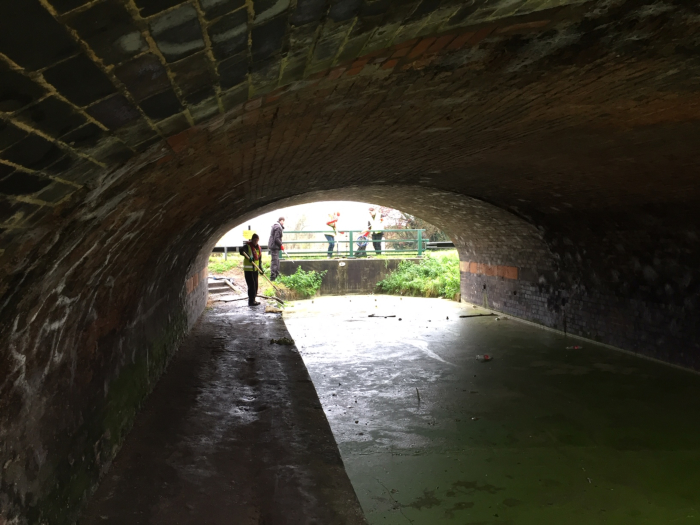


Trent Lock looking downstream towards the River Trent

Trent Lock looking upstream

Trent Hauling Bridge
Trent Lock
Trent Hauling Bridge, Bridge 1, spans the entrance to the canal outfall, with the first lock, Trent Lock L1, lying 20 yards back. The river towpath which crosses the canal entrance going east is part of The Trent Valley Way, stretching a distance of 84 miles to West Stockwith, near The Humber estuary. There was no towpath along the lock beneath the footbridge, so the broad beam canal boats had to moor below the lock, and were hauled by rope capstan into the chamber. In periods of high water during Winter/Spring, with the river in spate, entering the narrow mouth of the lock with a fully loaded vessel would have been quite challenging.
Trent Lock used to have an extra pair of gates fitted at the head of the lock, mitred in the opposite direction to the operational lock gates. This was part of a flood defence system to prevent inundation by rising river levels of the low lylng LadyBay area.
Flood control systems subsequently built at Holme Pierrepoint, further down river, have now superceded this precaution. The head of the lock is now permanently sealed by a substantial blue brick wall with the culvert controlled by a penstock.
Trent Lock Rally 1973
This rally enabled boats to attend from all parts of the inland waterways. The society had negotiated with Trent Water Authority, the then owners of Lock 1 together with the pound alongside Nottingham Forest Football Club, to allow them to clear the lock chamber and make the lock operable. Once completed, arrangements were then made for a rally using the lock for access from the River Trent. The pound between the lock and railway bridge was used as the rally site which was easily accessible from the towpath. The first boat through the lock was Elizabeth, a converted 70ft narrow boat, reputed to be the last boat to leave the Grantham before the final closure in the 1930's. Many boats locked through and the pound was full of moored craft. The rally was a huge success


Mr McCarthy arriving with members of the society at the river bank near Forest Football ground. With him (from left), Mr Chris Tizzard, (rally organiser), Mr Garland Grylls (chairman) and Sir Dennis and Lady Le Marchant.
Our thanks to Mrs. Val Roberts who was at the rally in her boat ’Woolaton’ and who sent us the adjacent press cutting taken from
The Nottingham Evening Post on 15th October 1973
Trent Link
The closure of the railway line from Nottingham to Melton Mowbray in 1968 removed the rail services across the River Trent over Ladybay Bridge and the next bridge over the Grantham Canal. Subsequently, both the Trent and canal crossings were converted into roads and the canal culverted. Ever since, there have been suggestions for constructing a new route for the canal re-connecting it to the river.
The Polser Route, has survived the critique of time to remain probably the route with the least range of problems. Hopes of the campaigners were raised in 1998, when a group consisting of British Waterways, Volunteer Organisations and Local Authorities submitted a grant application to The Millennium Fund, that included ‘The Polser Brook’ as the connection to the Grantham Canal.

Over the years different groups have worked on both a 'green corridor' and a 'green Infrastructure master plan', so as to make the route more appealing to fund. These plans also included the restoration of the Grantham Canal from Gamston to Cotgrave and to protect wildlife sites and include safe recreational links across the A52. Economic conditions at the time resulted in improved trails and paths but nothing changed on the canal.
Another opportunity may present itself as the prospect of a fourth road crossing, first proposed in the 1930s is again on the planner’s agenda. This is possibly connecting main routes near to Colwick on the north bank and the A52 near Radcliffe on Trent. Major housing development at Tollerton Airfield may also be an opportunity to restructure the road systems in the Gamston area where the canal is crossed by the A52 and also Radcliffe Road in West Bridgford. Such opportunities may help or hinder the restoration of a Trent Link.
What the future holds for the Trent Link is difficult to predict. Without it the canal stays landlocked, but there are many locks and bridges to be rebuilt before this beautiful canal is ready to be ‘connected’.
Fosse Way The A46
Running diagonally across the country from the south coast near Exeter to Lincoln, using the rivers Severn and Trent in parts for added security, the Roman Fosse Way travels unerringly its 200 plus miles.
In our region, we have the Roman fort of Margidunum, thought to be the largest along this road. Margidunum is perhaps more familiar as the name of the big roundabout on what is now the ‘old’ Fosse Way near Bingham.
These Roman interlopers made life a little uneasy for our native Corieltauvi tribe whom, largely occupying the area we now call the East Midlands, had been quite happily getting on with things for a couple of thousand years or so when the Romans came and unsettled them. Iron Age finds have been discovered at Margidunum. To give you a handle on these times; Boudica, Queen of the Iceni in East Anglia was busily knocking six bells out of the Romans; intent on taking her lands bequeathed to her by her father – gawd, she was riled!
Still on the Fosse, and towards Newark; a mere 1,400 years later, we have the last battle of the Wars of the Roses at East Stoke – not wishing the facts to get in the way of a good story – the battle of Bosworth Field also lays claim to being the last.
It is thought by some, that East Stoke may have been a larger battle than that of Bosworth. However, archaeologists working for the Highways Agency (HA) on the dualling of the Fosse Way - less romantically if you must – the A46, found little evidence of this battle.

The dualling of the A46, reminds of another battle a little south of Margidunum – the Battle for Joshua Mann’s Bridge! Too recent to be mentioned in history books, this was our own battle to prevent HA from making life difficult – and a tad expensive for us. We didn’t emerge victorious; which means we lost. This 2010 Battle was mainly between British Waterways and the Highways Authority. The Grantham Canal Partnership and the Grantham Canal Society supported British Waterways in this fight.
No blood was spilled; each allowed to present their case in an orderly fashion to the inspector at the public enquiry.
HA built us a wonderful £2.2mn bridge(17a) taking the A46 over the canal – if that’s not an endorsement of our aim to full navigation

New Fosse Bridge (Bridge 17a)

Old Fosse Bridge No 18
The issue was Joshua Mann’s Bridge(16). This bridge fell just 1mtr outside the parameters of the road improvement works, and because of the new design of the associated Stragglethorpe junction, it’s going to make it a lot more expensive to raise Joshua Mann’s Bridge in the future, being technically more challenging and disruptive.
Ideally we would have liked HA to have replaced Joshua Mann’s Bridge as part of the works – being incorporated into the re-engineering of the Stragglethorpe Intersection. When this started to look unlikely, a compromise solution was put forward to raise Stragglethorpe Road by 1.75mts. This would still involve re-engineering the canal to include an additional lock when the time came to putting the canal through. Sadly, this too was looked upon unfavourably by the HA, insistent their work wouldn't prevent Mann’s Bridge from being raised in the future. The inspector of the public enquiry ruled in our favour. Ultimately, the decision lay with the secretary of state for transport, which went the other way – falling in the midst of the general election probably didn't help.
The only concession, after being pressed, was to install a Toucan crossing for towpath users crossing the busy Stragglethorpe Road.
What the Battle for Joshua Mann’s Bridge did do for us, was to increase awareness and support for the society.
Bridges are numbered from the River Trent in ascending order so the New Fosse Bridge should be numbered 17a followed by bridge 18, the Old Fosse Bridge. Maybe at some time the marker on the new bridge will be corrected.
Contributors & Acknowledgements
The Grantham Canal Society gratefully acknowledges the contributions made by the following who have provided details and photographs to help complete this publication.
Editor
Steve Swann
Photography
Our particular thanks to Dave Healey for allowing us to use many of his splendid photos
Also our grateful thanks to the following for the use of their photos: Steve Swann, Tony Jackson, Jim Freeman, John Clark, Ann Moulsher, Angela & David Davis, Mike Lane, Bernard Jessop, Dave Cross, GCS Archive, Ken Brockway, Paul Watson, Peter Stone, Mark Hubbard Maggie Shirran,, John Manterfield, Humphrey Platts, Debbie Spencer Grantham Library, Leicester Library, Science Museum Group Collection Roz Symonds, Belvoir Castle
Publications
Grantham Matters, Britain From Above, Grantham Memories
Contributors
Tony Jackson, Mike Atherley, David Lyneham-Brown, Fred Marsh, Peter Stone, Mike Stone
Bibliography
The Grantham Canal. Early Days: R. Philpotts
The Grantham Canal Today: Chris Cove-Smith
The Grantham Canal Guide: Tony Pitman
‘Meander Through The Beautiful Vale of Belvoir’: Grantham Canal Society
Waterways Guide: Nottingham, York & the North East. Collins Nicholson
Heather Lackey: Dissertation
The Ironstone Quarries of the Midlands Parts 1, 8 & 9: Eric Tonks
The Railway Magazine


