


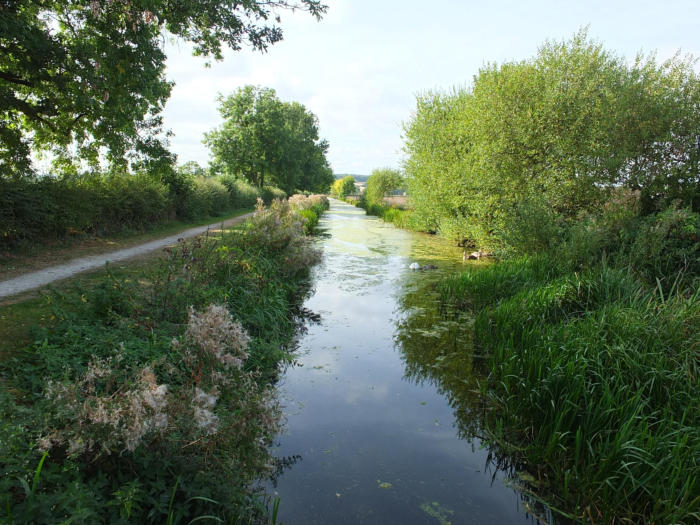


Bingham Link
Several people have speculated over the years about whether a canal link had ever been built between the Grantham Canal and Bingham. It is certainly not there now, but in our newsletter no 37 of Bridge in 1975 an article was written by Chris Bates giving evidence of its existence. This article was given a second ‘airing’ by Mike Atherley in the June edition of Bridge published in 2019

Dry Section
William Jessop, the canal's engineer, encountered some criticism due to his difficulties in sealing the canal here. The porous gypsum strata proved a challenge for the canal builders, both from delaying its opening, to having to close shortly afterwards to be repuddled with clay. The dry section extends for approximately five miles. It appears, eventually, to have held water reasonably well until; according to an eye witness, in 1958, the canal was too deeply dredged and a culvert running under the canal bed was damaged, allowing water to escape. Fortunately, we have engineering solutions today, which will enable this section to be fully restored to water. The majority, if not all of this work, is within the scope of volunteers.

The re-watered dry section between bridge 21 and lock 11 that had been temporarily re-watered in 1971 when British Gypsum were emptying a new quarry locally.
Hickling
The section of canal from Hickling to Grantham was overseen by William King. King was also responsible for the design and construction of both Knipton and Denton Reservoirs. At a similar time he was also Estate manager at Belvoir Castle and advisor to the 4th Duchess.
The warehouse adjacent to Hickling Wharf was built late 18th or early 19th C. In 2019 it was converted to a Tea Room. The local pub is the Plough Inn.


‘Baby Grumplin’ - a small 2 berth wooden cruiser. This boat was a creation by Jill and Chris Tizzard who lived near Hickling Basin at the time. Baby Grumplin’s name came from the Daily Mirror’s cartoon strip called the Perishers which first appeared in 1959 For the Grantham Canal Restoration Society, who adopted the name, Baby Grumplin came in various guises. It could be a small two berth wooden cruiser, illustrated above and moored in Hickling Basin during the 70’s. It was also a mock up narrow boat that could be carried in a small car trailer and taken to away events.


Hicking Lengthsman's Hut
The Hickling Lengthsman’s Hut is located beside the towpath just over 650 metres from Hickling Bridge (Bridge 30) on the Grantham Canal going in the Grantham direction. It had been in a dilapidated state for many years and the subject of many discussions regarding its future and reconstruction.
The Hickling Lengthsman’s hut was most likely built at the end of the 19C. Its walls were constructed from upended wooden railway sleepers and was complete with a brick fireplace and chimney. It had a pitched planked and felted roof and a plain earth floor.
Hickling Local History Group comment that Hickling’s last Lengthsman was Shelton Walker who farmed the fields to the north of the towpath. His son, John, planted Shelt’s Spinney a little further east (by the swing bridge) in his memory. These days, this is an extraordinary wildlife haven, particularly for woodland birds.
The Hickling Lengthsman’s Hut is an extremely rare example of a building of this type. See www.hicklingnottslocalhistory.com/lengthmans-hut/
In March 2014, a team from the Grantham Canal Society and Hickling Parish Council undertook the first stage of the restoration of the hut, which was then completely lost in the undergrowth.
The first task was to clear the area around the hut and rebuild the chimney which was undertaken by Grantham Canal Societies volunteers early in 2014.
The wooden structure was later dismantled and removed to CRT’s workshop in Newark where the work to restore and rebuild it was passed to CRT’s Heritage Trainees in 2019. New timber, which had been previously sourced, together with the existing was treated and weatherproofed. August 2020 saw the building project completed by the Canal and River Trust.


Trent Lock looking downstream towards the River Trent

Trent Lock looking upstream

Trent Hauling Bridge
A Lengthsman’s responsibility was to maintain his ‘length’ of the canal and there would have been several placed along the towpath between Nottingham and Grantham particularly where there were no lock-keepers cottages. The task of the original Lengthsman dates back to the middle ages where they were employed to keep the roads passable by either the Lord of the Manor or local parish council. Lengthsman’s huts were usually built at the time of a canal’s construction for shelter and storage, however, most have disappeared over time with only two remaining on the Grantham canal.

Kinoulton
Bricks were originally manufactured in Kinoulton at a site near to the ‘Old Schoolroom’. The canal served for both raw material and transporting the finished product. There was a wharf alongside with stone edgings but is overgrown and difficult to see. Kinoulton brick was used in building a number of dwellings in the village including the church, Field Farm, Bishops Close and many more that now have a rendered exterior. The original brickworkers lived in Bailey’s Row at the east end of the village
Pasture Hill Farm was purchased in 1919 by Sir Jesse William Hind, a Nottingham solicitor, as a place to train destitute orphans. He renamed the farm Vimy Ridge in dedication to his son, Lieutenant Jesse Francis Montague Hind, who was killed in action on September 27th 1916.
Sir Jesse, previously of the Park in Nottingham, planted an avenue of 184 Lombardy Poplar trees to commemorate his son and the officers and men of the 9th Battalion of The Sherwood Foresters Regiment who died during the battle of the Somme at Vimy Ridge over the period 7th July to 30th November of 1916.
The avenue of Poplars runs 1 km west from Owthorpe Lane and terminates at the farm. A number of trees have been replaced by new planting of the same species as part of the village of Kinoulton's Millennium celebrations and in 2007/8 a further 70 trees were cut down and replaced by Notts County Council. The trees are included in the War Memorial Register, No 59076, in memorial of the 9th Battalion of the Sherwood Foresters.

Contributors & Acknowledgements
The Grantham Canal Society gratefully acknowledges the contributions made by the following who have provided details and photographs to help complete this publication.
Editor
Steve Swann
Photography
Our particular thanks to Dave Healey for allowing us to use many of his splendid photos
Also our grateful thanks to the following for the use of their photos: Steve Swann, Tony Jackson, Jim Freeman, John Clark, Ann Moulsher, Angela & David Davis, Mike Lane, Bernard Jessop, Dave Cross, GCS Archive, Ken Brockway, Paul Watson, Peter Stone, Mark Hubbard Maggie Shirran,, John Manterfield, Humphrey Platts, Debbie Spencer Grantham Library, Leicester Library, Science Museum Group Collection Roz Symonds, Belvoir Castle
Publications
Grantham Matters, Britain From Above, Grantham Memories
Contributors
Tony Jackson, Mike Atherley, David Lyneham-Brown, Fred Marsh, Peter Stone, Mike Stone
Bibliography
The Grantham Canal. Early Days: R. Philpotts
The Grantham Canal Today: Chris Cove-Smith
The Grantham Canal Guide: Tony Pitman
‘Meander Through The Beautiful Vale of Belvoir’: Grantham Canal Society
Waterways Guide: Nottingham, York & the North East. Collins Nicholson
Heather Lackey: Dissertation
The Ironstone Quarries of the Midlands Parts 1, 8 & 9: Eric Tonks
The Railway Magazine


